The FCC's "military-grade" drone proposal: what's in scope and how to comment by September 2
.svg)
Quick Summary
Quick summary
- What happened. On July 21, 2026, the FCC's Public Safety and Homeland Security Bureau and Office of Engineering and Technology released Public Notice DA 26-758, opening PS Docket No. 26-189. It proposes to prohibit continued importation and marketing of previously authorized foreign-produced drones and drone components on the FCC's Covered List that qualify as "military-grade."
- Why it matters. The FCC's definition of military-grade includes any UAS that carries a thermal imaging sensor, any UAS that carries LiDAR, and UAS docking stations. Those are standard payloads for commercial use cases including facade inspections, roof scans, topographic mapping and dock-based automated flight programs.
- This is a proposal, not a final rule. Comments are due September 2, 2026.
- Equipment you already own keeps flying. The proposal does not ground aircraft already in the field. Continued use and operation of purchased equipment is expressly outside its scope.
- The proposed wind-down is 180 days. If the FCC adopts the prohibition, importers, manufacturers, distributors and retailers would have 180 days after Federal Register publication of that final action to stop importing and marketing covered equipment. The FCC has requested comment on the duration of the wind down period, so it could change
- A separate action taxes much of the same equipment sooner. An August 13, 2026 Presidential Proclamation imposes tariffs on imported UAS and components starting September 3, 2026, at 100 percent for large drones, thermal-equipped drones and docking stations.

Why this action is different from December 2025
The December 2025 Covered List addition only applied to new models of UAS and UAS critical components. This proposal would ban the sale of relevant UAS models and components that are currently being sold in the U.S.
In December 2025, the FCC added all foreign-produced UAS and UAS critical components to the FCC Covered List. That action was forward-looking. It blocked new equipment authorizations, which in practice meant new models could not enter the U.S. market. Aircraft that already held an authorization stayed authorized, and dealers could keep importing and selling them.
The July 2026 proposal would, if adopted, impact existing authorizations.
In other words, December 2025 governed which models could be introduced into the U.S. The proposed rule would determine whether current “military grade” models can continue to be imported and sold. So, for example, a thermal-equipped DJI drone that has been legally purchasable all year could stop being purchasable after the wind-down period expires.
The FCC has proposed a 180 day wind down period, rather than the ten days it used in June, citing the larger scope of equipment involved and the shorter time this equipment has been listed. That number is a proposal, and the length of the transition is one of the questions the Commission is asking about.

How the FCC defines "military-grade"
The notice sets out seven categories. Any covered UAS or UAS critical component falling into one of them would be in scope. Categories 3, 4 and 5, in particular, have the potential to impact many commercial data capture operations.
- UAS weighing 55 pounds or more at takeoff, meaning aircraft outside the FAA's "small unmanned aircraft" definition at 14 CFR 107.3.
- UAS capable of dispensing "economic poison" as the FAA uses that term at 14 CFR 137.3, which reaches agricultural spray platforms.
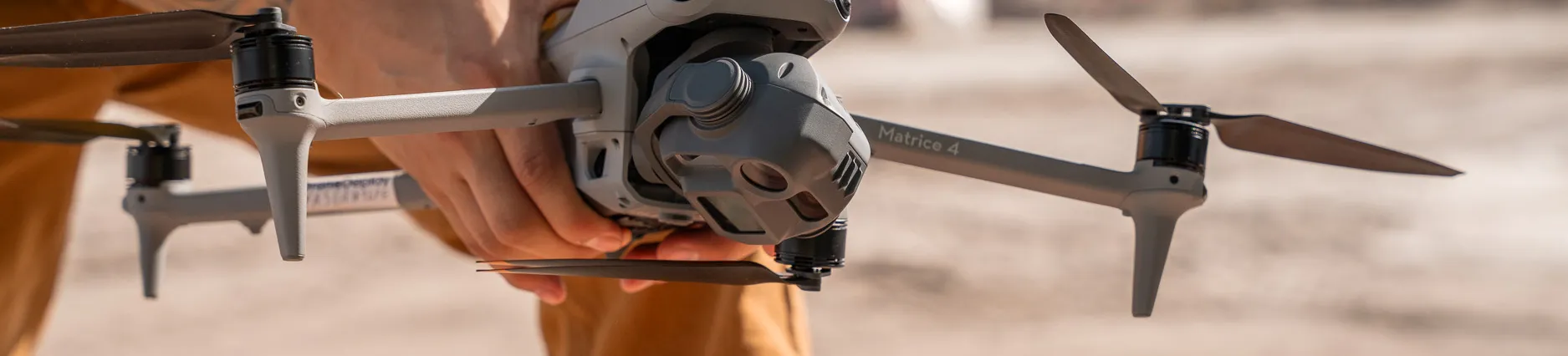
- UAS that contain or integrate thermal imaging sensors.
- UAS that contain or integrate LiDAR sensors.
- UAS docking stations, defined as multipurpose systems that let an aircraft land, take off, recharge or swap batteries and transfer data or payload.
- UAS specially designed to incorporate a defense article under 22 CFR 121.1, Category VIII(a)(5).
- Swarming UAS, covering both ground control stations and flight control systems built for autonomous multi-aircraft coordination, and aircraft purpose-built for synchronized formation flight. The notice names multi-UAS light shows specifically.
What is outside the proposal
The carve-outs matter as much as the categories.
- Non-military-grade UAS and components. A standard mapping airframe with an RGB camera is not in scope.
- Domestically produced UAS and components.
- Equipment on the DCMA Blue UAS Cleared List, and equipment qualifying as a "domestic end product" under the Buy American standard at 48 CFR 25.101(a).
- Equipment granted a Conditional Approval by the Department of War or DHS. Anything later removed from the Covered List falls out of scope with it.
- Importation and marketing for federal government use, and for commercial testing and product development.
- Continued use and operation of already-purchased equipment.
.jpg)
A separate action: Section 232 tariffs
On August 13, 2026, the President issued a Proclamation imposing Section 232 tariffs on imported UAS and UAS components, following a Commerce Department national security investigation. This is a separate action from the FCC proposal, though the subject matter is similar and rates track the FCC's categories:
- 100% on drones with a maximum takeoff weight above 25 kg, that integrate thermal imagers, and docking stations and certain components, effective September 3, 2026.
- 25% on other UAS at 25 kg or less, with the same effective date. This tariff rate is applied to a further set of components effective February 9, 2027, deferred to give domestic production time to ramp.
There are exceptions, including lower rates for drones produced in certain allied countries, subject to supply chain requirements, as well as a deferred implementation date of February 9, 2027 for companies on the DoW's Blue List or holding conditional approvals.
How to comment
Comments are due September 2, 2026, in PS Docket No. 26-189. All filings are public.
- Read the source documents. The Public Notice, DA 26-758, the Federal Register notice at 91 FR 48870 and the docket entry on Regulations.gov.
- File electronically through the FCC's Electronic Comment Filing System at fcc.gov/ecfs. Enter proceeding number 26-189.
- Questions on the proceeding go to Chris Smeenk, Attorney Advisor, Operations and Emergency Management Division, PSHSB, at 202-418-1630 or [email protected]. Accessible formats are available at [email protected] or 202-418-0530.
The notice specifically asks for input on the following.
- Scope of the seven categories. Does the list adequately capture military-grade equipment? Are there items on it that are not military-grade, or items missing that are?
- Whether the risk is distinctly acute. Does military-grade equipment pose particularly acute risks of the kind described in the underlying National Security Determination from December 2025, beyond those already attributed to foreign-produced UAS generally?
- Economic and supply chain impact. How would the prohibition affect consumers, providers and manufacturers, and what weighs for or against it? The Bureau tentatively concludes impacts would be minor and contained, and strongly encourages data and specific evidence of economic cost.
- Availability of domestic alternatives. Do domestic alternatives exist? Would the proposal be cost-effective for the public in obtaining trusted equipment, and would compliance costs fall as operators move to it?
- Economic benefits. The notice cites billions raised by domestic UAS producers since the December 2025 listing and asks what additional domestic investment this prohibition would generate.
- Public interest balance. Do the national security benefits outweigh negative economic or supply chain factors, and are there other public interest considerations either way?
- The length of the transition period. The Commission asks whether 180 days is right and wants concrete numbers to work from, including the quantity of devices already imported and held for sale, new or recently updated models en route or pending shipment, and devices under executed distribution, marketing or sales agreements not yet in the supply chain.
If your program has fleet inventories, replacement quotes, payload lead times or contracted purchases that would be affected, that last question is where the evidence belongs.
How to prepare
None of this requires grounding any of your existing fleet, but timing is likely to change. Tariffs, which go into effect as soon as September 3, 2026, will impact pricing. And the proposed 180-day wind down period for import and sale of covered systems and parts has the potential to more drastically reduce availability.
If you keep a country-of-origin SOP, this is the moment to write those dates into it and revisit fleet composition, refresh sequencing and spare-parts inventory against them. Consider referring to the SOP framework in our earlier guide, How to manage your drone fleet in a changing legal landscape.
About DroneDeploy
Leading construction, energy and agriculture customers rely on DroneDeploy to capture their sites with drones, 360 cameras, mobile devices and ground robotics. Our platform is hardware-agnostic by design, and we support a broad range of manufacturers. Aircraft and components are available to DroneDeploy customers through the DroneDeploy hardware store.
Contact a DroneDeploy product expert
This post is provided for general information purposes and should not be taken as legal advice. Compliance teams should review the Public Notice and their own situation directly.
.png)
FAQ
Related articles



Ready to learn more?
Contact sales to see how DroneDeploy can give your teams the power to document and analyze your sites from the air and ground – all in one AI-powered platform.