Navigating federal drone restrictions for contractors: A practical guide for operators
.svg)
.png)
Quick Summary
It is important to understand that these restrictions aren't “new” in spirit – they are the final implementation of the American Security Drone Act (ASDA) adopted as part of the 2024 National Defense Authorization Act.
While previous rules focused on procurement, as of December 22, 2025, contractors are now strictly prohibited from operating UAS from "covered foreign entities" (such as DJI or Autel) on federal contracts.
The Golden Rule: If federal dollars – grants, loans, or contracts – are involved, you cannot fly a restricted drone.
In December 2025, new operational restrictions officially went into effect, marking a major milestone for rules that have been in development for years.
While the 2024 National Defense Authorization Act (NDAA) (see Subtitle B, Drone Security) had already prohibited the purchase of Chinese-manufactured drones using federal funds, we have now reached the implementation phase where the operation of these drones is also restricted on government-funded projects.
If you are a drone operator or program manager touching federal contracts, grants, or other government-funded projects, here is how to navigate these changes without grounded operations.
Which projects are covered?
The restriction is project-based, not a universal ban on your company. However, "federal work" is broader than just jobs for the Department of Defense. It includes:
- Direct Federal Contracts: Any project where a federal agency is the client.
- Federally Funded State/Local Projects: This includes state highway projects funded by federal grants or local disaster relief efforts.
- The "Flow-Down" Effect: Even if you are a subcontractor for a local firm, if the ultimate source of funding is federal, these restrictions typically "flow down" into your contract.
- Cautionary Over-Compliance: Note that some state and local agencies may implement these same restrictions even on non-federal projects to simplify their own compliance or avoid any risk of future funding audits.
Important exceptions
The goal is national security, not an industry standstill. To that end, several significant exceptions exist:
- Non-Federal Work: This is the big one. These rules do not stop contractors from using Chinese drones on private commercial projects, residential work, or purely locally-funded jobs – even if they are separately providing services to the federal government or on federal projects.
- Agency-Specific Exceptions and Waivers: The law includes specific exemptions for the Department of Transportation (DOT) and FAA for operations critical to public safety or the efficiency of the National Airspace System. Other exemptions exist for national security, intelligence, and law enforcement missions, though you should consult with legal counsel before relying on any of these exceptions.
Options for federal projects?
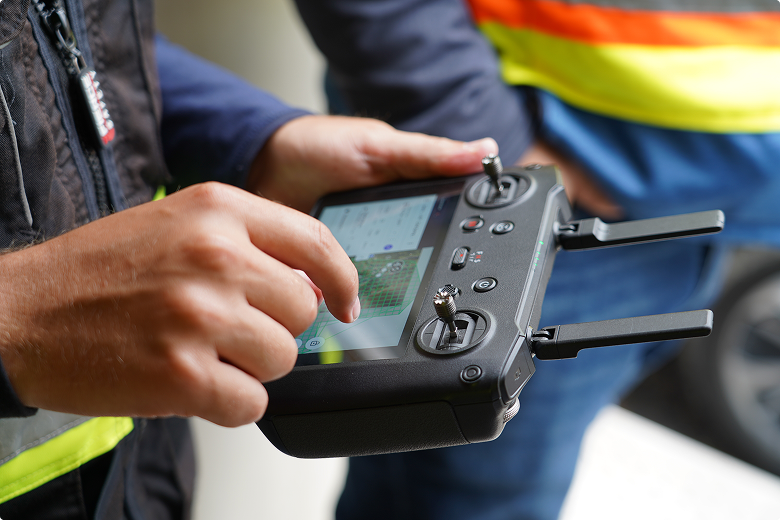
For those working on federal projects, there are clear paths forward to remain compliant while maintaining high-quality data collection.
- Blue UAS Cleared List: These drones are pre-vetted by the Department of Defense and are fully exempt from the operational restrictions.
- Non-Chinese Options: Manufacturers from the U.S. and allied nations offer robust alternatives that do not fall under the “covered foreign entity” definition.
- Fleet Agnostic Software: Because DroneDeploy is hardware agnostic, you can manage a diverse fleet – flying DJI for private work and transitioning to a compliant alternative for federal projects – all within the same platform.
For a detailed look at compliant hardware, visit the DroneDeploy Hardware Guide.
A practical playbook
The best approach is to be educated and organized rather than reactive.
Step 1: Map Your Funding Sources: Identify which projects in your pipeline are fully or partially funded by federal dollars and which are purely private.
Step 2: Segment Your Fleet:
Bucket your drones into two categories:
- Federal-Eligible: Blue UAS or other non-covered aircraft.
- General Commercial: Drones perfect for your private-sector work.
Pro Tip: Physically label your aircraft "FED-OK" or "NO-FED" to prevent accidental use on the wrong jobsite.
Step 3: Strategize Your Procurement: On federal projects, "off-the-shelf" restricted drones remain non-compliant regardless of where they are purchased. If you need compliant hardware for a specific project but aren't ready to buy, consider utilizing professional flight services or specialized rental programs to bridge the gap.
Step 4: Monitor for Future Developments: As written, the ASDA sunsets in five years, meaning that, if it is not reauthorized, it will expire in December 2028.
.jpg)
A separate development: The FCC Covered List
While the ASDA and NDAA focus on procurement and operation, you may also see news regarding the FCC's “Covered List.” This is a separate regulatory development that could impact the future authorization of new equipment in the U.S. For more data on how this affects hardware availability, read this blog post.
Contact a DroneDeploy product expert
This post is provided for general information purposes and should not be taken as legal advice. Compliance teams should review relevant legal requirements themselves to understand how they impact their unique situation.
.png)
FAQ
Related articles

Ready to learn more?
Contact sales to see how DroneDeploy can give your teams the power to document and analyze your sites from the air and ground – all in one AI-powered platform.